
Department for External Church Relations
The site uses cookies to help show you the most up-to-date information. By continuing to use the site, you consent to the use of your Metadata and cookies. Cookie policy
Issue No. 112 of Church and Time (Tserkov i Vremia) Journal Published
DECR Communication service, 03.09.2026
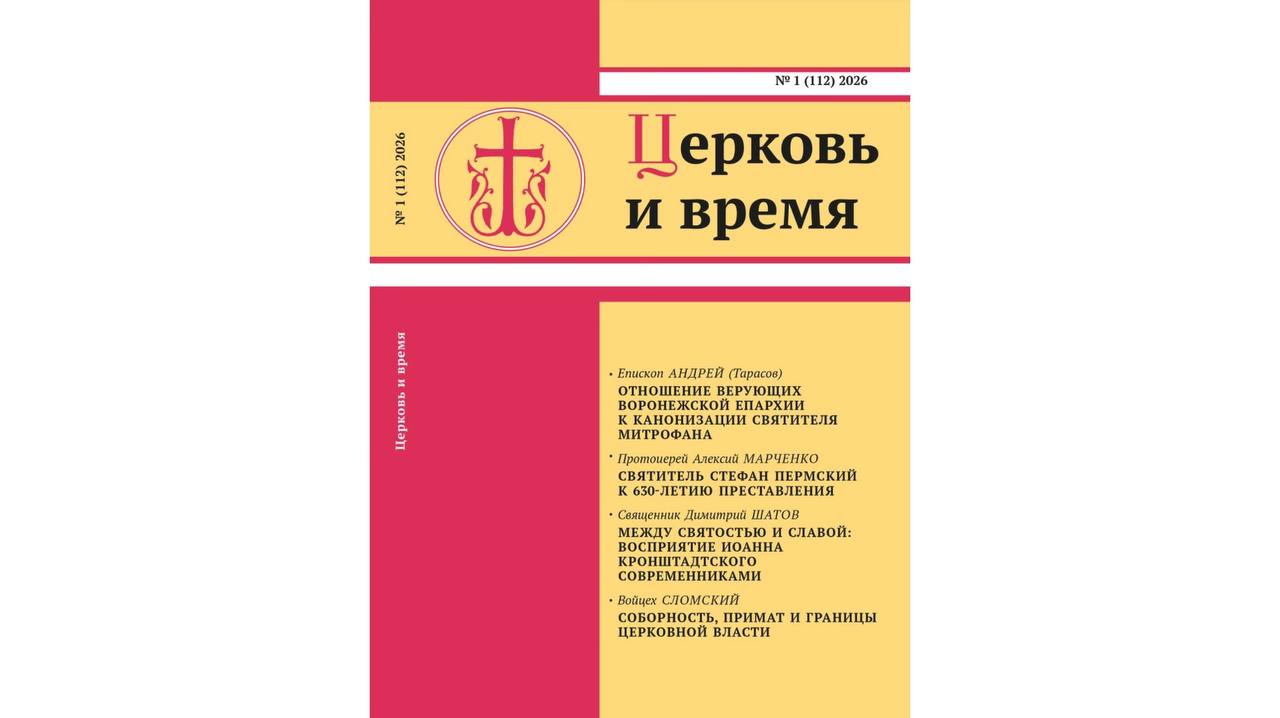
The 112th issue of Church and Time (Tserkov i Vremia), a scholarly theological and church-and-society journal published with the blessing of His Holiness Patriarch Kirill of Moscow and All Rus’ by the Ss. Cyril and Methodius Theological Institute for Postgraduate and Doctoral Studies in cooperation with the Department for External Church Relations of the Moscow Patriarchate, has been published. The issue features materials devoted to relations between the Church and society, as well as theology and Church history, the Russian Orthodox Church’s Educational Committee reports.
The new issue opens with an interview with Archpriest Alexy Marchenko, Head of the Doctoral Studies Department at the Ss. Cyril and Methodius Theological Institute for Postgraduate and Doctoral Studies and Professor at the Department of Church History and Canon Law of the Institute, entitled “St. Stephen of Perm – a Great Russian Saint.” The publication marks the 630th anniversary of the repose of St. Stephen and examines his spiritual succession to the great Christian enlighteners of the ninth century, Ss. Cyril and Methodius, Equal-to-the-Apostles. The article explores the significance of St. Stephen’s missionary labours in preaching Orthodoxy among the peoples of the Russian North, creating the Zyrian alphabet, and translating liturgical literature into the native language of the Komi-Zyrians. It highlights the multifaceted nature of St. Stephen’s spiritual labours: preaching the word of God to pagans, baptizing the Zyrian people, ascetic self-denial, pastoral care of the Diocese of Perm, and confessing Christ in the face of threats and humiliations from pagan opponents of Orthodoxy. The article also clarifies the connection between St. Stephen of Perm and St. Sergius of Radonezh, as well as the extent and nature of the Zyrian enlightener’s participation in the Russian state’s development of the northern territories. The author also addresses key questions concerning the history of the evangelization of the Russian North: what accounted for the success of St. Stephen of Perm’s preaching, and what significance does his spiritual feat have for the contemporary life of the Russian Orthodox Church and the Russian people as a whole?
An article by Priest Dimitry Shatov, Head of the Department of Historical and Pastoral Disciplines at Kaluga Theological Seminary, examines how the contemporaries of St. John of Kronstadt (1829–1908) perceived his personality as a religious and social phenomenon at the turn of the nineteenth and twentieth centuries. The author notes the polarity of these attitudes, ranging from veneration to slander, and identifies two principal tendencies in the interpretation of the saint’s personality. The first, “rationalistic,” approach explains the popularity of Righteous John in terms of social and psychological factors. The second, “spiritual,” tendency attributes the widespread veneration of the pastor to his faith and life of prayer. Particular attention is given to the conflation of the concepts of holiness and popularity, which, according to the author, reflected the processes of secularization taking place in religious consciousness at the time.
The theological section continues with an article by Polish researcher Wojciech Słomski, Professor at Vizja University in Warsaw, entitled “Conciliarity, Primacy and the Limits of Church Authority: The Council of Constantinople of 879–880 and the Problem of Church Unity from an East-West Perspective.” The study focuses on the relationship between the concepts of conciliarity, primacy and the dogmatic Tradition in the context of the ninth-century East-West conflict. The article offers an ecclesiological examination of the horos and acts of the Council, emphasizing its role in establishing the principle that no ecclesiastical authority has the right to alter the profession of faith of the universal Church. Particular attention is paid to the issue of the Filioque, the reception of the Councils of 869–870 and 879–880, and the relationship between the Creed, conciliarity and Church unity. The author clarifies the meaning of the Byzantine understanding of conciliarity, which has its dogmatic foundation in the teaching that the Church, in a conciliar manner, bears witness to the faith that it preserves and transmits. The genuine doctrinal authority of a Council consists in expressing and bearing witness to the faith, rather than exercising authority over its content.
An article by Bishop Andrew (Tarasov), a doctoral candidate in Church History at Moscow Theological Academy, appears in the historical section of the journal and examines the attitude of the faithful of the Diocese of Voronezh toward the canonization of St. Mitrophan of Voronezh (1832–1896). The publication aims to fill existing “gaps” in the study of the significance of the canonization of St. Mitrophan of Voronezh for his contemporaries. Drawing on materials from the Diocese of Voronezh, the article analyzes public perceptions of the canonization among those who participated in the event, as well as the development of veneration for the Voronezh saint, as reflected in the construction of churches and side chapels dedicated to him.
The issue concludes with an article by Priest Mikhail Sergeev, a doctoral candidate at the Department of Church History and Canon Law of the Ss. Cyril and Methodius Theological Institute for Postgraduate and Doctoral Studies, entitled “The Journal Voice of the Lithuanian Orthodox Diocese as an Example of Upholding the Position of the Russian Church in Emigration in the Second Half of the 1920s–1930s.” The article examines the efforts to uphold the ecclesiastical policy of Metropolitan Sergius (Stragorodsky) during a challenging period in Church history. The author analyzes the circumstances surrounding the journal’s establishment and the particularities of its assessment of events taking place in Lithuania, the Soviet Union and Europe. The article identifies the journal’s key themes: apologetics, cultural and educational work, history and social issues.
The Church and Time journal is available for purchase at the Knizhnaya Palata v Chernigovskom Cultural and Educational Centre.
Patriarch
Department Chairman
Sermons
01.10.2026
16.09.2026
15.09.2026
24.01.2021
06.11.2020