
Reception at Christ the Saviour Cathedral in Moscow Marks the Day of Slavic Literature and Culture and Name Day of His Holiness Patriarch Kirill
DECR Communication Service, 24/05/2026
On 24th May 2026, after the Divine Liturgy, a reception took place at the Cathedral of Christ the Saviour in Moscow, marking the Day of Slavic Literature and Culture and the Name Day of the Primate of the Russian Orthodox Church. His Holiness Patriarch Kirill of Moscow and All Rus’ shared a repast with participants in the celebrations.
Among those who delivered addresses on that festive occasion were: Metropolitan Juvenaly (Poyarkov); Metropolitan Varsonofy of St. Petersburg and Ladoga; Metropolitan Veniamin of Minsk and Zaslavl, Patriarchal Exarch of All Belarus; Ms A.Yu. Kuznetsova, Deputy Chair of the State Duma of the Russian Federation; Mr I.O. Shchyogolev, Plenipotentiary Envoy of the Russian President to the Central Federal District; Mr L.Ye. Slutsky, Leader of the Liberal Democratic Party of Russia, Chairman of the State Duma Committee on International Affairs; and Mr A.V. Shaposhnikov, Chairman of the Moscow City Duma.
Metropolitan Niphon of Philippolis, Representative of the Patriarch of Antioch and All the East, greeted His Holiness Patriarch Kirill on behalf of the Representatives of the Local Orthodox Churches to the Moscow Patriarchal Throne. His Eminence said, addressing the Primate of the Russian Church:
“Your Holiness,
“We, representatives of the Local Orthodox Churches to your holy Throne, extend to you our sincere congratulations on the commemoration day of your heavenly patron, and together with your people we honour the great saints of the Church – Cyril and Methodius, Equal-to-the-Apostles, back to whom goes the origin of the present-day spiritual wealth of Slavonic peoples. With modesty and humility, they were carrying out their mission, and thanks to them the Russian culture later became a part of the Christian civilisation.
“Through your name, your ministry, your theological and philosophical thoughts that you uncompromisingly express at various church and public gatherings, as well as through your firmness in observing church canons, we all, who live and serve under your omophorion, have felt more deeply the spiritual bond and timeless unity which link us to the great teachers of the Church whom we are commemorating today.
“Your Holiness, may our Lord, through the prayers of Saints Cyril and Methodius, grant you many years of life to the glory of the Holy Russian Church and the entire Orthodoxy!”
His Holiness Patriarch Kirill thanked all those present for their warm words and wishes.
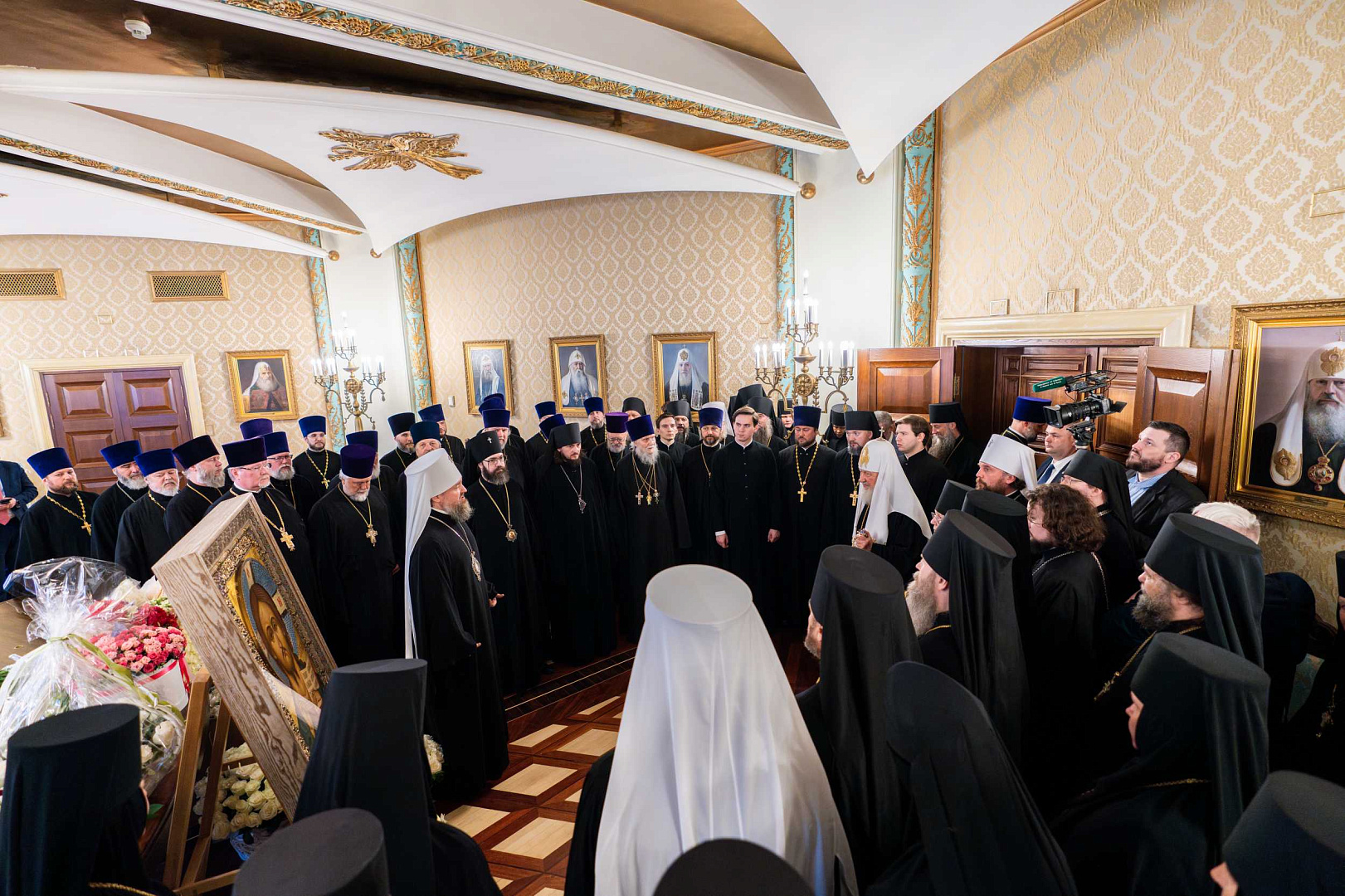
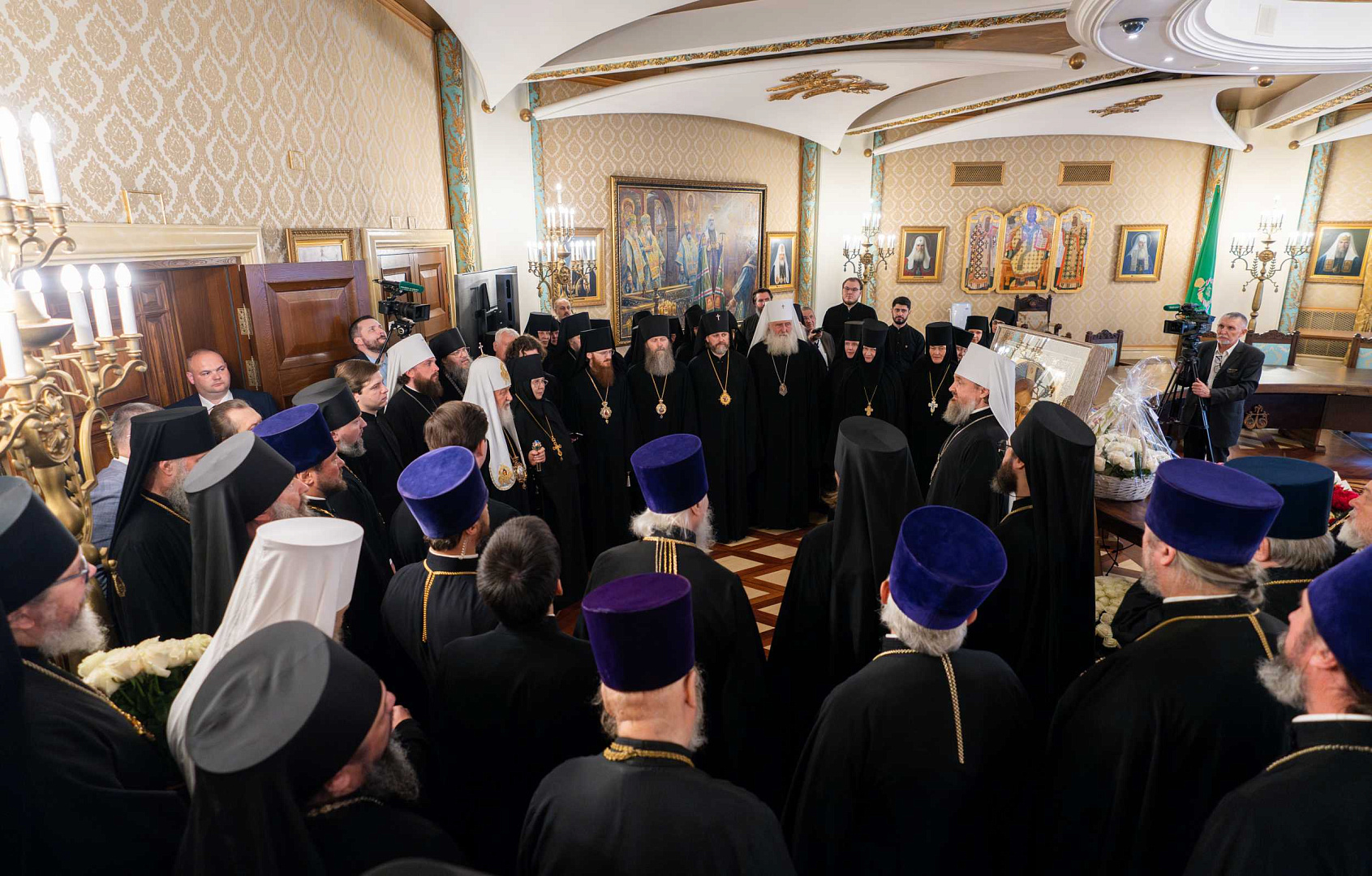
After the reception, in the Hall of the Supreme Church Council, the Moscow hierarchs and clergy congratulated His Holiness on his Name Day.
Metropolitan Grigory of Voskresensk, Chancellor of the Moscow Patriarchate and Patriarchal First Vicar for the city of Moscow, extended greetings to His Holiness Patriarch Kirill on behalf of the clergy, monastics and laity of the Moscow Diocese and presented to the Primate of the Russian Church an icon of the Saviour.
In 2016, with the blessing of His Holiness Patriarch Kirill, a tradition for the Moscow parishes to present flowers to the Primate of the Russian Church on feast days was replaced by campaigns raising funds for charitable causes. As Metropolitan Grigory reported, the funds raised on the occasion of His Holiness’ Name Day were donated to the St. Alexis Central Clinical Hospital to be used for purchasing medical equipment.
His Holiness Patriarch Kirill said in response to the greetings and warm wishes:
“I wholeheartedly thank you, Vladyka Grigory, and all of you, dear vladykas, fathers, mothers the abbesses, brothers and sisters for your kind words and, above all, for your work!
“Much was done in Moscow, in the Moscow Metropolia, over the past years, and we should not keep silent about it, because all this may serve for edifying purposes. Perhaps, it was done largely on the Patriarch’s initiative, but it was done by all of you and those standing behind you – our brothers and sisters in monasteries, parish rectors and priests and youth leaders. Through their work, they are shaping such a style of the Church’s relationships with society, people and authorities that was not known before, even under the emperor, truth be told.
“Back then, there were chief procurators. Some of them were non-believers, like Prince A.N. Golitsyn, who once said to one of the permanent members of the Synod: ‘Yes, I am the Chief Procurator. But I said to His Majesty the Emperor that I could not be the Chief Procurator because I don’t believe in God and I am a Mason.’ But His Majesty replied: ‘Off you go, you will manage.’ So here I am, managing.’ So maybe that was why everything collapsed later? All that could not stand firmly while such were the church-state relations.
“And later, our people and our Church went through terrible hardships of the 20th-century godlessness. However, by the mercy of God, nowadays our Church’s situation and church-state relations are somewhat unprecedented. History did not know such examples. In the past, there were favourable conditions, but it was either in the context of the authorities’ dominance over the Church or, as was most often the case, in moments when authorities were not doing much to ensure the well-being of the Church. And the Church, which developed within the framework of the state paternalism, was unable to act independently. No appointment to episcopal sees was made without obtaining approval from the Chief Procurator of the Most Holy Governing Synod, and some of those, as I have already said, were non-believers.
“Then came the Soviet authorities. There were people in power who used to be seminarians and remembered the previous style very well. Even when in the 1940s Stalin partly restored relations with the Russian Orthodox Church, he acted based on the pre-revolutionary system of church-state relations. So, he established the Council for the Affairs of the Russian Orthodox Church and the Council for the Affairs of Religious Cults, which were later transformed into the Council for Religious Affairs. The chairman of the Council for Religious Affairs was in fact that same chief procurator of the Most Holy Governing Synod. Without his consent, no appointment could take place.
“Today the Church is truly free. None of those in authority has either capacity, or power, or desire to govern the Church. Yet, this places on us special responsibility before God, before the Church itself, before our people and before history. So, may God help us to work – as they used to say after the Great Patriotic War – for ourselves and for that guy killed in action. We must labour for ourselves and for our predecessors who could not work in the way we now can. They had no such opportunity. Not because people were bad, but because there was no opportunity.
“May God help us all – bishops, rectors, priests, abbesses, each at our own place – to devote our efforts to strengthening Orthodox faith in our people, for we are responsible today for strengthening Orthodoxy in the Russian land.”
Then, in the Throne Hall of the Patriarchal Chambers, His Holiness received congratulations from Mr V.V. Volodin, Chairman of the State Duma of the Russian Federation; Ms A.Yu. Kuznetsova, Deputy Chair of the State Duma of the Russian Federation; Ms O.B. Lyubimova, Minister of Culture of the Russian Federation; Mr I.M. Rudenya, Plenipotentiary Envoy of the Russian President to the Northwestern Federal District; Ms A.Yu. Popova, head of the Federal Service for the Oversight of Consumer Protection and Welfare, Chief State Sanitary Physician of Russia; Mr D.F. Mezentsev, Presidential Representative in the Constitutional Court; Mr S.A. Gavrilov, Chairman of the State Duma Committee on Ownership, Land and Property Relations; Mr A.Yu. Vorobyov, Governor of the Moscow Region; cosmonaut and Hero of Russia Ye.O. Serova; Mr A.V. Shaposhnikov, Chairman of the Moscow City Duma; Mr V.I. Suchkov, head of the Moscow City Department of National Policy and Interregional Relations; Mr V.V. Mikhaylov, First Deputy Managing Director of the Russian Railways; Mr A.A. Guryev, President of the Russian Fertilizers Producers Association; Mr A.G. Guryev, Vice President of the Russian Union of Chemists; Mr A.V. Levin, Acting Director General of the “Sofrino” Art Production Enterprise; and Mr Ye.O. Blagov, head of the “Russky Krest” Charity Foundation.
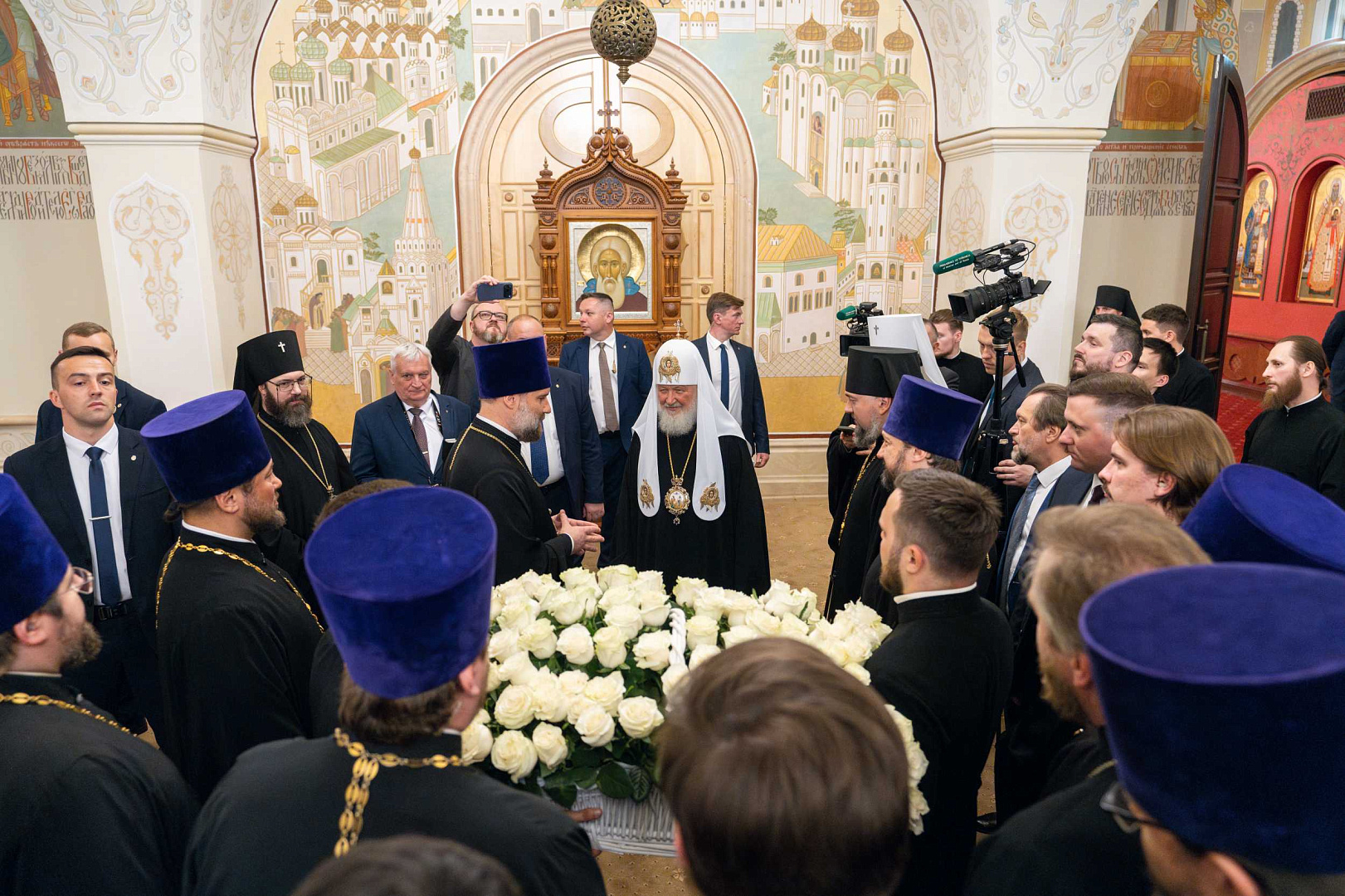
Later, in the Sergius Hall of the Cathedral of Christ the Saviour, His Holiness Patriarch Kirill of Moscow and All Rus’ was greeted by the hierarchs and clergy who had taken part in the Divine Liturgy.