
Department for External Church Relations
The site uses cookies to help show you the most up-to-date information. By continuing to use the site, you consent to the use of your Metadata and cookies. Cookie policy
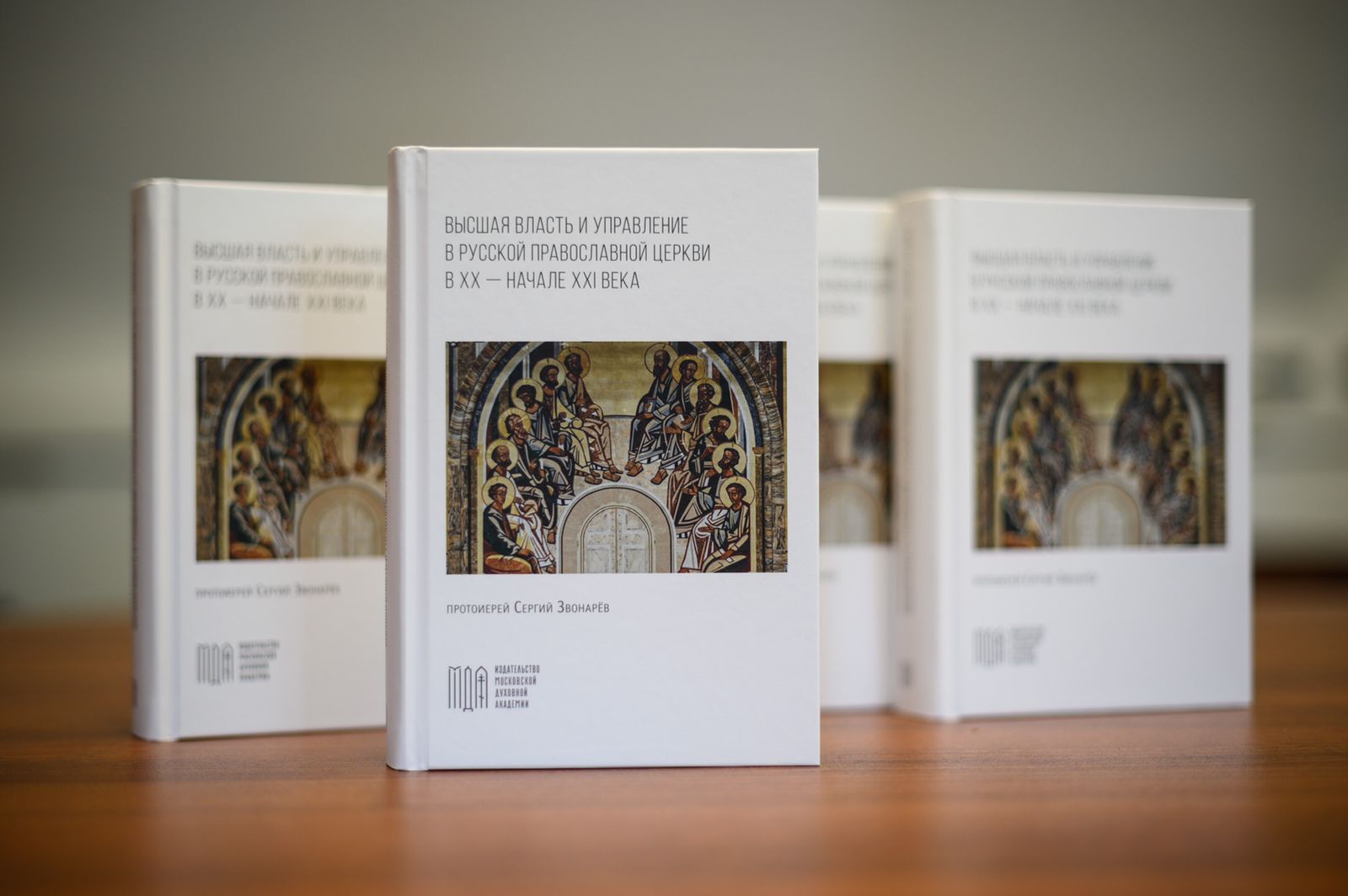
Publishing House of the Moscow Theological Academy produces book by DECR secretary on the affairs of the distant abroad.
DECR Communication service, 16.07.2023.
On 14th July the publishing house of the Moscow Theological Academy issued a monograph by the candidate of theology and secretary for the affairs of the distant abroad of the Department for the External Church Relations of the Moscow Patriarchate archpriest Sergei Zvonarev, reports the press service of the MTA.
The editor of the book is doctor of theology and advisor to the Patriarch of Moscow and All Russia archpriest Nikolai Balashov.
The scholarly researched book is devoted to a historical and ecclesiastical canonical analysis of the evolution of the higher authority and administration of the Russian Church throughout a hundred-year period that heralded far-reaching changes in church life as preparations were being made for the Local Council of the Russian Orthodox Church in 1917-1918 and the revolutionary upheavals that were taking place in Russian society that led to the dictatorship of anti-church policies for many decades, as well as the revival of various aspects of church life with the emergence of the present-day new Russia.
The book deals with the expectation of changes in the administration of the Russian Church at the turn of the twentieth century, the plans for ordering church authority and administration, the life of the metropolitan districts and the Church-State relations through the Inter-conciliar Presence, the pre-conciliar convocation and the Council itself. The works pays special attention to the process of working out by members of the All-Russian Church Council of 1917-1918 a conciliar-patriarchal structure of ecclesiastical administration founded on a system of balances of decision-making between the Local Councils on the one hand and the Patriarch, the Holy Synod and the Supreme Church Council on the other.
The functioning of the supreme ecclesiastical authorities and church administration as proposed by the Council was paralyzed by aggressive atheistic policies which compelled the Church to fight not for the implementation of conciliar decisions but for her own existence and the securing of apostolic continuity. The Episcopal Council of 1943, the eightieth anniversary of which will be marked in the current year, became the beginning of a gradual formation of central ecclesiastical administration which the Church could use in conditions of non-freedom but which was far removed from what the 1917-1918 Council aspired towards. The first step towards implementing the Conciliar decisions in the realm of higher ecclesiastical authority and administration was undertaken in the year of the celebration of the Millenium of the Baptism of Rus in1988 and the following step was taken at the celebration of the second millennium of Christianity.
However, at present the process of the good ordering of various aspects of the institution of higher ecclesiastical authority and administration is still ongoing and strives to meet the demands of the Church as well as takes into account the realities of the public life and Church-State relations.
The book may be of benefit for ecclesiastical legislators, church and secular researchers, students of the theological schools of the Russian Church and all those who take an interest in the historical legacy and the experience of Church-State relations in the past and present and for students of canon law.
The work contains a bibliography on the topic and an index of names. It may be purchased at the internet shop of the MTA.
Patriarch
Department Chairman
Sermons
05.01.2026
24.12.2025
24.01.2021
06.11.2020