
Metropolitan Anthony of Boryspil and Brovary: Protecting Shrines and the Rights of Believers is a Profession of Faith
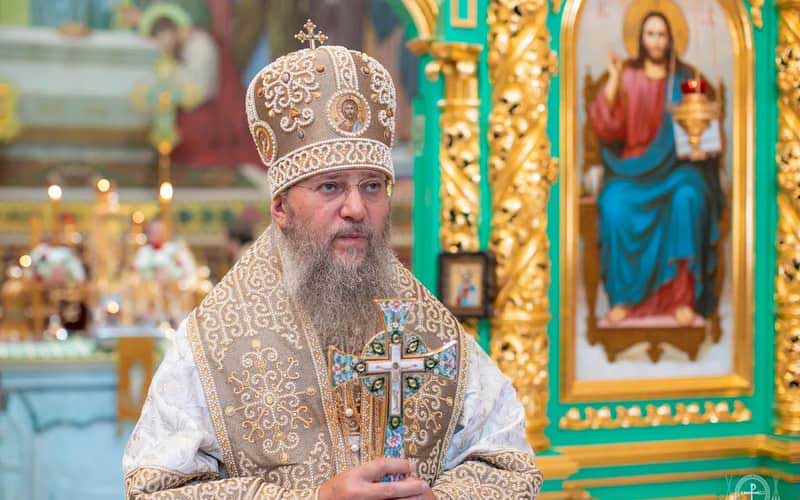
DECR Communication Service, 29.12.2025.
Metropolitan Anthony of Boryspil and Brovary, chancellor of the Ukrainian Orthodox Church, gave an interview to the Serbian portal Život Crkve (Life of the Church), in which he answered questions about the situation of the canonical Church in Ukraine.
— Your Eminence, allow us to thank you for agreeing to give an interview to our portal. Our first question is how do matters stand with the threat of complete ban of the Ukrainian Orthodox Church and the expropriation of its churches and property?
— Unfortunately, the process of banning the Ukrainian Orthodox Church is going on, and we should not expect this issue to be removed fr om the agenda in the near future, no matter that it is absurd and runs counter to the current Constitution of Ukraine, other legislative acts, and international law. Three court hearings took place so far; the next one is scheduled for February 24, 2026. Moreover, in several regions attempts have been made to restrict the activities of the Ukrainian Orthodox Church at the local level, along with attempts to seize church buildings and monastic complexes and transfer them to another confession.
Also, there are facts of legal and administrative pressure on our communities concerning property and registration of religious organizations. Nowadays, they do not even bother to organize fictitious meetings for a “transfer” to the “OCU”, but quietly re-register a church building or other church property to that confession, and the new “owners” come to our priest and tell him that the church is no longer ours. Meanwhile, the structures of the state security ensure the enforcement of such judgments. This is precisely how the so-called “free transference” of our parishes to the “OCU” is carried out, about which speakers of that confession are so fond of talking too much.
At the same time, it should be noted that the issue of the complete and total ban on the Ukrainian Orthodox Church remains extremely complex, both legally and practically, because our Church is a very large religious community with millions of believers, thousands of parishes, monasteries, and clergy. Any attempts at a total ban inevitably have legal, social, and humanitarian consequences. Experience has shown that even when a church is taken away from us, the parishioners and priests remain faithful to the Ukrainian Orthodox Church. They have to gather for worship in apartments or other suitable premises, while the most seized churches, unfortunately, stand empty, because those who had seized them never intended to worship. For them, it was a political action, sometimes taken according to their convictions, but more often being financially motivated.
In church terms, it is important to emphasize the key point that the Church is not identical to property and buildings. Churches and monasteries are great shrines and historical heritage, but the Church lives above all in the Eucharist, in faith, and in the community of believers. History knows many examples of the Church being deprived of church buildings, but not ceasing to be the Church. At the same time, protecting shrines and the legitimate rights of believers is not a political struggle, but a form of the profession of faith, performed peacefully, lawfully, and with Christian dignity. The Church has already experienced such times, and the following words of the Apostle are especially appropriate today: “We are treated as sorrowful, yet always rejoicing; as poor, yet making many rich; as having nothing, and yet possessing everything” (2 Cor. 6:10).
After all, the destiny of the Church is in God’s hands, and no external hardship can destroy the Body of Christ. Facing the trials, the Church is called to the lack of fear, faithfulness to the Lord and hope in Him, while remembering His words, “And lo, I am with you always, to the close of the age” (Mt. 28:20).
— On more than one occasion we have read about the seizures of church buildings of the Ukrainian Orthodox Church by supporters of the “Orthodox Church of Ukraine”, which is recognized by the Ecumenical Patriarchate of Constantinople. This transgression of the law also includes the beatings of believers and the defiling of holy places. In Cherkasy, for instance, the ruling bishop nearly lost his life during an attack. Please tell us, has the Ukrainian Orthodox Church received any signal from Constantinople during the time of lawlessness that the Phanar condemns the seizures and is ready to make every effort to stop the unlawful actions of the “OCU” supporters?
— So far, we do not know of any public, official and explicit statements made by the Ecumenical Patriarchate that would directly and plainly condemn the seizures of church buildings of the Ukrainian Orthodox Church, violence against its faithful, desecration of holy places, or attacks on bishops and clergy. Nor have there been any calls to the “OCU” supporters to stop such actions immediately and keep canonical and civil order.
This silence is offensive and deeply painful for our faithful, since violence, coercive measures, and the seizure of holy places are incompatible with the spirit of true Christianity. The Holy Fathers clearly taught us that the truth of the Church is not maintained by force, and grace cannot act through lawlessness. St. John Chrysostom wrote, “The Church does not need violence, since truth is inherently powerful.”
It is important to stress that the primary responsibility for concrete unlawful acts lies with those who commit them, and no church and political decisions can justify beatings, threats, and desecration of church buildings. Silence or no clear moral assessment offered by church authorities, whatever their motives are, does not absolve them from responsibility before God.
In this situation, the Ukrainian Orthodox Church has chosen the path of patience and prayer, with no responding to evil with evil, but bearing witness to Christ not by force, but by faithfulness, which corresponds to the evangelic and patristic spirit. As St. Maximus the Confessor said, “Truth triumphs not when it overcomes an opponent, but when it is being kept by love.”
— Greek media has written that a possible solution of the church crisis in Ukraine could be the unification of the Ukrainian Orthodox Church with the “OCU”. How realistic is this scenario?
— We deeply grieve the separation of the Orthodox community in our country and suffer from it. However, the Church has its own laws of life, which must be put front and centre at the solution of any occurring problem. An attempt to consider the unification of the Ukrainian Orthodox Church with the “OCU” demands first and foremost an ecclesiastical, canonical, and spiritual approach, rather than a political or rational one.
In Orthodox theology and church practice, the unification of Churches is not an administrative act or a merger of structures, but the making of true unity in spirit and truth, based on liturgical communion in the Holy Mysteries, recognition of the canonical foundations and mutual love in Christ.
While dealing with this issue, it is vital to have a correct church vision, since different concepts are often confused in secular and even in church discussions. In Orthodoxy, the unification is possible only as the restoration of canonical and Eucharistic unity, but not as a compromise forged between religious structures or as an administrative merger of organizations. The Church is not a union by agreement, but the Body of Christ, living by the grace of the Holy Spirit. Therefore, it must be clearly stated that the unification is possible only on canonical grounds. The history of the Church shows that all real reconciliations had happened thanks to the return to canonical communion, restoration of apostolic succession, and penance for church divisions and transgressions. Without these, the point at issue could be only a kind of extraneous agreement, but not church unity.
In terms of canon law of the Orthodox Church, the “OCU” has appeared outside the canonical order, without legitimate apostolic succession, and on the basis of schismatic structures that had been condemned earlier. I would like to recall that before 2018 the so‑called “Ukrainian Orthodox Church of the Kyiv Patriarchate” and the “Ukrainian Autocephalous Orthodox Church”, which merged into a single body as the “OCU”, were considered schismatic by all Local Orthodox Churches, including the Patriarchate of Constantinople. No action prescribed by the canon law of the Orthodox Church and consistent with its spirit and tradition of bringing schismatics back to the fold of the true Church was undertaken. What took place was legalization, not the healing of a schism. Thus, any talk about the “unification of two Churches” is incorrect in the strict Orthodox sense, since the Church cannot unite with anything existing outside its canonical and sacramental life.
Therefore, the manner in which the unification is sometimes discussed in the media as a compromise or mutual recognition without canonical resolution of the matter is inapplicable and not acceptable for the Orthodox Church. It contradicts the foundations of the church life and destroys the notions of grace, the Holy Mysteries, and apostolic succession.
I would like to stress once more that we want to have one Church in our country, but precisely the Church founded by Christ the Saviour, for which the commandment of love is the cornerstone, and the canonical norms are the main instrument for resolving both simple and complex problems, and we are praying for this church.
— There is the Exarchate of the Patriarchate of Constantinople in Ukraine. Is it an influential structure? Could it become a centre that would unite those Orthodox hierarchs and faithful who under no circumstances would wish to join the “OCU”? How realistic is the renewal of communion between the Ukrainian Orthodox Church and the Patriarchate of Constantinople?
— First and foremost, we must name the fundamental principle, which is that in Ukraine there exists one and the only one canonical Orthodox Church, namely, the Ukrainian Orthodox Church. It alone has the uninterrupted apostolic succession, canonical hierarchy, the fullness of sacramental life, and historical roots in the life of Orthodox Christians in Ukraine. In this sense, only the Ukrainian Orthodox Church is really capable of uniting the faithful, not in terms of administration, but in the Eucharist, in Christ and in the grace of the Holy Spirit.
So far as the Exarchate of the Patriarchate of Constantinople in Ukraine is concerned, it is neither an influential nor an independent structure. Its activities are rather of auxiliary and representative nature. Therefore, an idea that the Exarchate could become a kind of alternative “centre of unification” for Orthodox hierarchs and faithful who do not recognize the “OCU” is not in line with Orthodox ecclesiology. Uniting in Orthodoxy is neither a structure as such nor a legal affiliation, but life in the canonical Church, wh ere the apostolic faith, canons, and the unity in the Eucharist are preserved. It is impossible to create a new “centre” without them.
As to a probable renewal of communion between the Ukrainian Orthodox Church and the Patriarchate of Constantinople, it has to be said that the Church always lives in hope for peace and the renewal of communion, because any division is a wound on the Body of Christ. However, such a renewal can be realized only on the basis of canonical truth, rather than through ignoring the violations of church order. The true renewal of communion could be possible only after the recognition of the Ukrainian Orthodox Church as the sole canonical Church in Ukraine; the renunciation of supporting schismatic structures; and the return to the conciliar resolution of issues affecting the fullness of Orthodoxy existing throughout the world.
Without the observance of these conditions, no external forms of “coexistence” or “parallel centres” will lead to the true peace in the Church.
— How do you feel about the announced visit of the Pope of Rome to Kyiv? Could this visit result in the intensification of efforts to form a union in Ukraine?
— There is the Pope’s stand on the matter to consider not least of all. He has underscored on many occasions that his possible visit to Kyiv depends exclusively on the end of war and the advent of peace. This is not about immediate practical steps, but about a hypothetical visit, which the Pope views first and foremost in the humanitarian light and as a symbol, a gesture of support for suffering people and an appeal for the cessation of violence.
In Orthodox terms, any visit by the head of the Roman Catholic Church to a territory of traditional Orthodox presence cannot be regarded neutrally, because historical experience shows that the problem of union has always brought about pain, divisions, and serious ecclesiological and theological contradictions. The memories of these events are alive and cannot be neglected.
It is also important to emphasize that in principle the Orthodox Church rejects union as a path to unity, since the true unity is possible only in the truth of faith, rather than in the subordination of one church tradition to another. This has been stated on many occasions at the church-wide level, including the Orthodox-Catholic dialogue. By the way, exactly this attitude can be found in the Joint Declaration signed by His Holiness Patriarch Kirill and Pope Francis at their meeting in Cuba in 2016. Unity cannot be built on the blurring of dogmas and ecclesiology. The Church is called to be vigilant and keep the faith without yielding to fear and rumors, as the Apostle teaches us, “Test everything; hold fast what is good” (1 Thess. 5:21).
After all’s said and done, the destiny of Orthodoxy in Ukraine is determined not by visits from abroad or diplomatic gestures, but by the Church’s faithfulness to Christ, the preservation of canonical order, and a life full of grace. This, rather than a union in any form, is the true path of the Church.