
“A special level of fraternal feelings”: the development of ties between the Russian Orthodox Church and the Malankara Church.
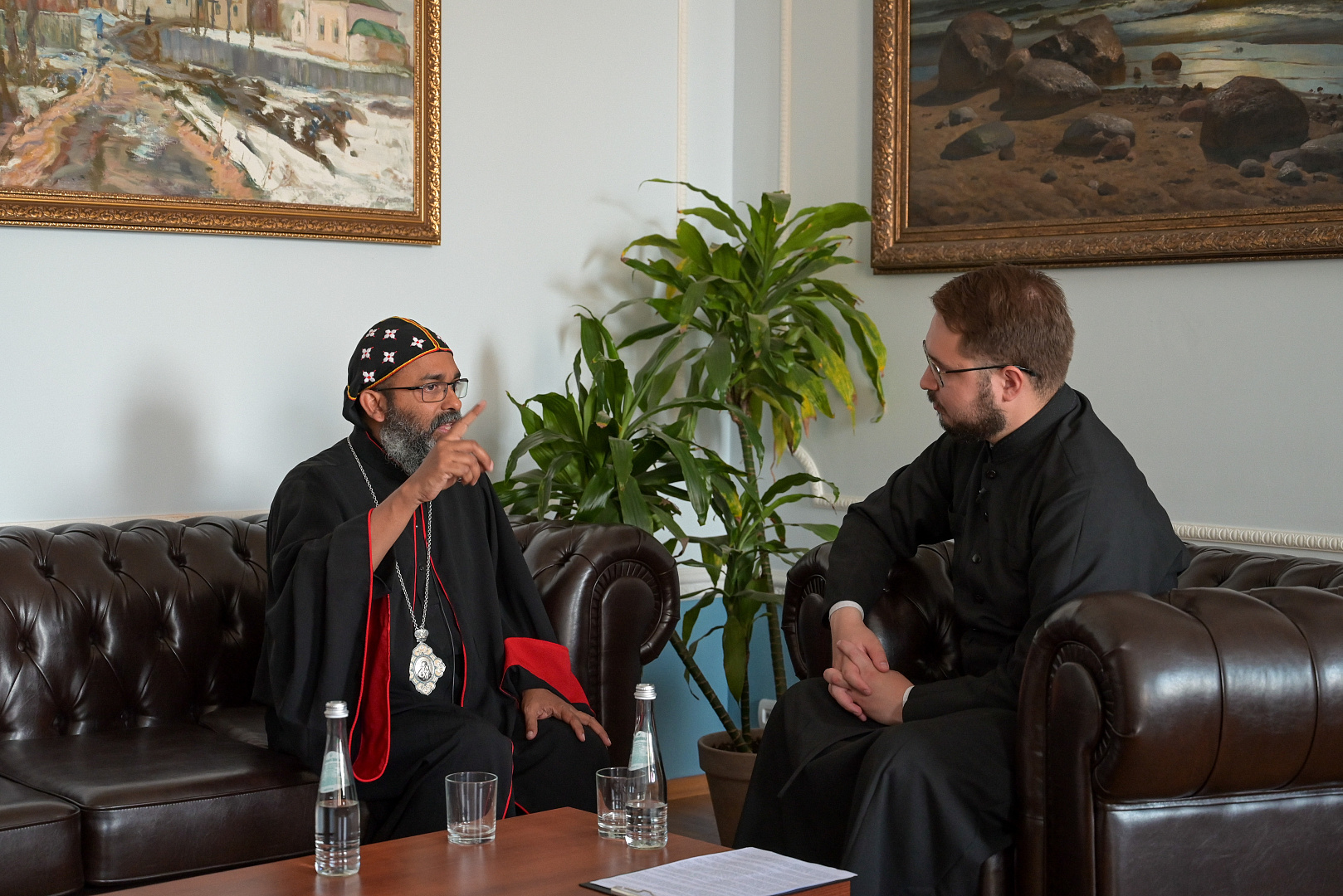
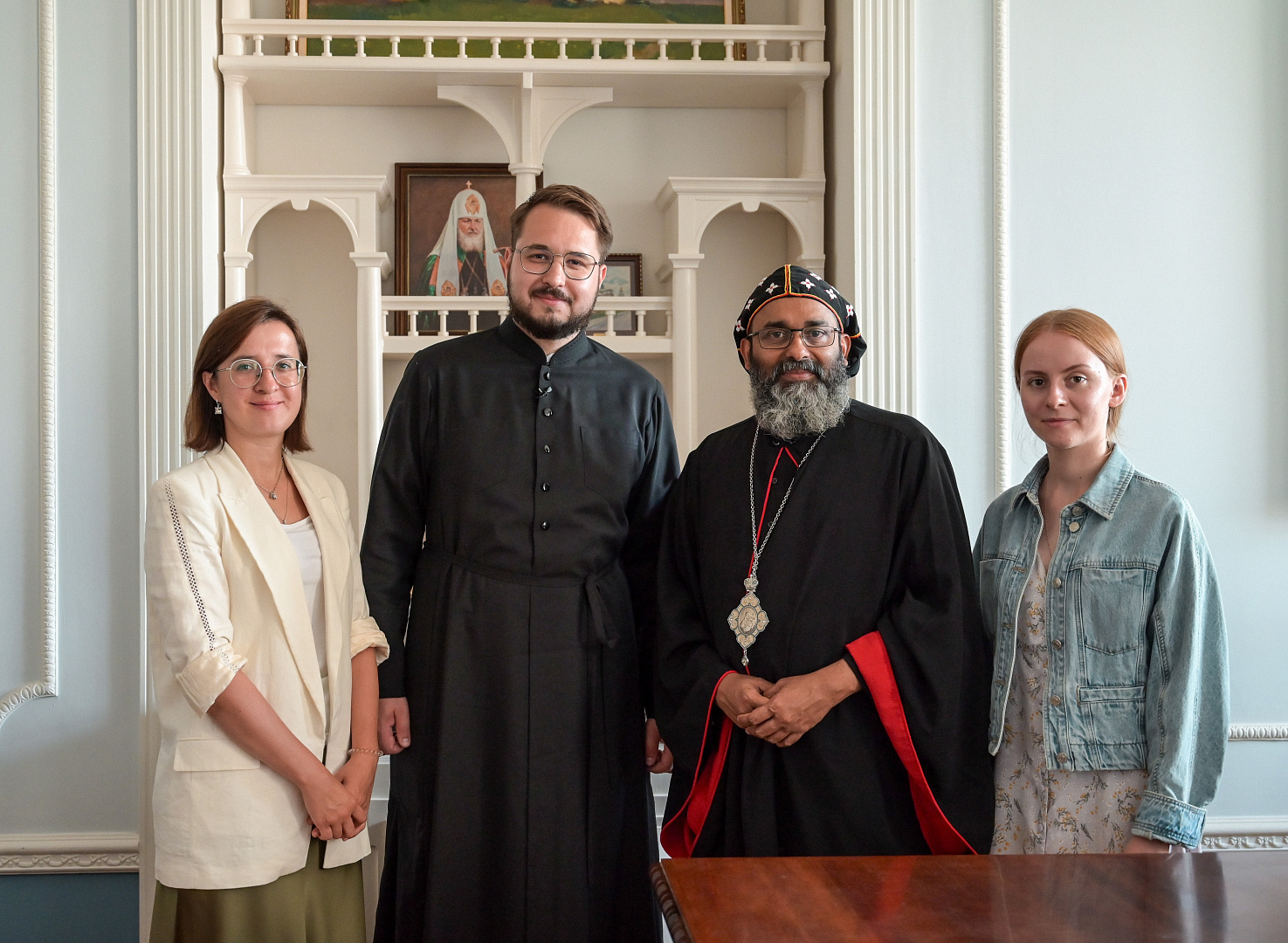
In July 2025, the Moscow Theological Academy hosted the fourth meeting of the Working group for coordinating relations between the Russian Orthodox Church and the Malankara Orthodox Syrian Church. In an interview with the portal Bogoslov.ru, Metropolitan Abraham Mar Stephanos, hierarch of the Malankara Church and head of the Diocese of Great Britain, Europe, and Africa, spoke about how this dialogue is developing, why veneration of Saint Matrona of Moscow is growing in India, and what challenges the ancient Church of Saint Thomas faces in the era of global migration.
– Your Eminence, the first question is about the Working group for coordinating relations between the Russian Orthodox Church and the Malankara Church. Its first session took place in 2020 in Kottayam (India), and the second in 2023 in Moscow. How are relations developing, and what results has the group achieved?
– Let me remind you how it all began. In September 2019, an official delegation of our Church, headed by our late Catholicos, His Holiness Baselios Marthoma Paulose II, visited Russia. During a private audience, the two Primates expressed their willingness to create a joint working group.
A landmark event was our joint visit to St. Alexy Hospital at the initiative of Patriarch Kirill. It was not originally part of the plan, but the Department for External Church Relations quickly organized everything, and fr om the Danilov Monastery we went there together. That visit became a turning point. Soon afterward, both Primates unanimously approved the proposal, and the first meeting was held the following year in India.
Since then, our long-standing friendly relations have received official recognition and have become closer to our faithful. In the age of social media, news spreads quickly, and many young people have begun to take greater interest in this direction.
– What issues are currently being discussed in the consultations, and what are the future plans?
– At the recent fourth session, we finalized the composition of participants fr om each side and drafted the agenda and further plans. The main focus will be on official consultations between our ecclesiastical families, which began with dialogues in Aarhus¹ (1964) and Chambésy² (1993). We also reviewed the joint statements and discussed future prospects.
In addition, we plan to conduct an analytical review of certain aspects of the Liturgy from both sides, and the Malankara Church will separately undertake a critical examination of the canons of the Fourth, Fifth, Sixth, and Seventh Ecumenical Councils. These are our immediate tasks.
– The Malankara Church sends students to study in the theological schools of the Russian Orthodox Church. How long has this tradition existed? How many students from India are studying in Russia now?
– The tradition of sending our youth to study in the theological schools of the Russian Orthodox Church began back in the Soviet era. The current Catholicos of our Church is a graduate of the Leningrad Theological Academy. He studied there when Patriarch Kirill was rector. We continue to send students to study theology, music, and iconography, after selecting them in our own seminaries.
I cannot give the exact number of students from the Malankara Church currently studying in Russia, but I know that one recently graduated from the Moscow Theological Academy’s Church Music Department. Two of our other students successfully defended their master’s theses after two years of studying the Russian language in St. Petersburg.
– In which other countries do your theological students study?
– Our students are enrolled at the Pontifical University in Rome, at the universities of Göttingen, Bonn, and Erfurt in Germany, and one person is completing a doctoral program in Leuven.
– In India you have two seminaries. How many students graduate annually?
– On average, about fifty from both seminaries combined. The seminary in Nagpur (North India) has a missionary orientation, and women study there as well. They can later serve in parishes or teach in seminaries. In Kottayam, only men study – future priests or lecturers.
– What theological topic is most relevant for the Malankara Church today?
– The Indian context is complex: multicultural, multilingual, multireligious. The key challenge is giving an Orthodox witness in such an environment. Another pressing issue is the preparation of clergy to serve in the diaspora, which is constantly growing. Our young theologians are focused on how to bear witness in a multicultural setting while also responding to the challenges of migration.
– Please tell us about the history of the Malankara diaspora in your diocese (Great Britain, Europe, Africa). When did this migration begin?
– The first wave came in the postwar years. After World War II, the first migrants from former colonies (Malaysia, Singapore, East Africa) arrived in England. Then came doctors, followed by a mass migration of healthcare workers, mainly nurses, to the United States. In the 1990s and 2000s, IT specialists joined them. A particularly significant surge occurred when the UK’s National Health Service opened new employment opportunities for nurses from India. This led to the establishment of new parishes, the arrival of priests, and a growing need for pastoral care. Very recently, student migration has increased as well. In Canada, wh ere there are many Indian students, we recently founded our newest diocese in the diaspora.
– Is the diaspora managing to preserve faith and culture?
– It is very difficult. The ministry of a priest or bishop in the diaspora is also filled with challenges. Nevertheless, I would say we are doing fairly well. When young people leave their homeland, they begin to miss the Liturgy, and a longing for the Church awakens in their hearts. On the other hand, standing firm in one’s life is also a struggle, full of its own difficulties. That is wh ere pastors, priests, and bishops must actively serve! It is wonderful that our dioceses have hospitality teams who are always glad to welcome new faces.
– Your Eminence, how are your relations with other Christian communities in India – other Orthodox jurisdictions, Catholics, Protestants?
– As Christians and followers of Saint Thomas, we remained a united community until the arrival of the Portuguese in the 16th–17th centuries. It was in the 17th century that we experienced our first division, after which disagreements began, often caused by the intervention of Churches fr om outside India.
As you correctly noted, there are now many different Christian Churches in India, and such diversity can sometimes be difficult. Sadly, we have had experiences that contradicted the true Christian witness. However, I would not say the future is hopeless. We look forward with hope!
We have dialogical relations with the Catholic Church and have also had bilateral dialogue with the Lutherans, although that has stalled at some point. At the same time, we everywhere maintain a “dialogue of life,” since we live in a mixed society and people and parishes interact with one another.
– Is the structure of dialogue with other confessions in India similar to relations with the Russian Church?
– I would say it is somewhat different. I must acknowledge that with the Russian Orthodox Church we have an entirely different level of fraternal feelings. But technically, our dialogue with the Pontifical Council for Promoting Christian Unity of the Catholic Church already has a 25-year history. We have three signed agreements, and it follows a clear agenda. With the Russian Orthodox Church we have so far held only four sessions, but we are full of hope for the future.
– Are the works of Russian theologians – such as St. Philaret of Moscow, St. Ignatius Brianchaninov, St. Theophan the Recluse, as well as Patriarch Sergius (Stragorodsky), Protopresbyter George Florovsky, Protopresbyter Alexander Schmemann, and Protopresbyter John Meyendorff – studied in the Malankara Church?
– Regarding the neopatristic synthesis and all the modern Orthodox theologians you mentioned – of course they are popular, studied, and read. In both of our seminaries, students and professors rely heavily on their works doctrinally. As for spiritual literature, the Philokalia is especially popular, thanks to one of our members who initiated its translation into English and Malayalam (our native language). Authors like Theophan the Recluse are read more for private devotion, contemplation, and inspiration.
– Are the lives of Russian saints translated into Malayalam? Are Russian saints known among your faithful?
– I would not use the word “veneration” of saints; rather, I would say communion or participation in their lives.
As for specific lives of saints, apart from the Philokalia, none have been translated separately. But the good thing is that English is the language of communication in our community, so everyone who takes reading seriously can access them in the original or in English translation.
You may find it interesting that after 2019 Saint Matrona of Moscow became very popular in our Church. This happened thanks to the personal veneration of Mother Matrona by our late Catholicos, His Holiness Baselios Marthoma Paulose II. It spread quickly. I myself have Malayalam translations of prayers for her intercession, which I keep in my prayer book and read daily. I know many people personally devoted to Saint Matrona. Before his repose, His Holiness testified that he had a vision of Saint Matrona, which transformed his spiritual life. So her veneration is definitely growing.
We also know of Saint Xenia of Petersburg, Saint Seraphim of Sarov… Our people, especially students, become acquainted with them mainly through literature. I see no theological obstacles to recognizing saints from other Orthodox Churches.
– Speaking of monasticism: earlier there were discussions about Malankara monks coming to Russia to become acquainted with Russian monasticism. Have those plans been realized?
– Yes. One of the greatest achievements was the visit of two of our nuns. They came here during the Russian winter, gained tremendous experience, and have practically become Russophiles. The spiritual dynamism of Russian monasticism was very positively received in our Church. We do not have many monks or nuns, but we are certainly aware of the strength of the monastic tradition of the Russian Orthodox Church, especially its remarkable growth in the post-Soviet period. At our bilateral meetings, we reflected deeply on this, and now several of our monks visit monasteries here. They testify that they were deeply spiritually inspired and impressed by the monks of the Russian Orthodox Church. Glory be to God!
– Do you plan to send more monks to Russia?
– Yes, of course!
– What is the current state of monasticism in the Malankara Church?
– As in Western Christianity worldwide, we face a serious decline in this vocation. We are not experiencing a decrease in the number of seminarians who wish to become priests, but as for monks and nuns, not many young people are choosing this path. Yet we know that in Orthodox spirituality the ascetic life is the backbone. We would very much like young monks and nuns to come, experience the spiritual power of monasticism, and carry that spirit in their hearts, becoming good examples for the younger generation.
– How many monasteries do you have?
– We have monasteries both in India and abroad – about twenty in total.
– Your liturgical traditions go back to the ancient Syriac liturgy. Are your students and monks familiar with the Russian Byzantine tradition? Has it influenced your liturgics?
– We preserve the West Syriac liturgical tradition intact in fasting, doctrine, faith, liturgical order, and calendar – all of this remains within our tradition. Strictly speaking, even at the turn of the millennium, in the 9th–10th centuries, in the Middle East, especially in Jerusalem, there were bilingual monasteries, and there was mutual influence between the Syriac and Greek traditions. For example, Greek influence is noticeable in Syriac liturgical hymns and tones. But even with great admiration for the Byzantine liturgical tradition, we keep the West Syriac tradition unchanged. I would not say there is strong influence, except perhaps in some visible expressions such as the use of prayer ropes – one of the aspects influenced by Byzantine practice. And of course, iconographic traditions have also influenced many of our parishes.
– What does a typical liturgical week look like for an average parishioner? How does it differ from the Russian tradition?
– For a believer, everything centers on the Sunday Liturgy. Everything revolves around the Sunday Eucharist. We begin with the daily services: Matins, the Third and Sixth Hours, followed by the Divine Liturgy. This lasts at least three hours.
– And is there a service on Saturday evening?
– Yes, on Saturday evening Vespers is always celebrated. In our tradition, which follows the West Syriac rite, the liturgical day begins with evening prayers on the preceding day. For example, Sunday begins with Vespers on Saturday. So preparation starts with Vespers. In our monasteries and seminaries, silence is observed after Compline as part of preparation for the Eucharist. For communicants, a six-hour fast from food before Communion is obligatory.
– How is preparation for Communion observed? Are there specific prayers? And regarding fasting — is it only the six-hour abstinence?
– In our oral tradition and practice, there are always preparatory prayers. There are also written prayers. Sometimes the prescribed prayers are read by the deacon, and the communicants repeat them after him. Some do this privately. It is also a matter of personal piety. As for fasting, six hours is the mandatory minimum. But beyond that it depends on the individual. Sometimes people take on additional obligations as a special offering. Some families have their own particular practices.
– In the Russian tradition, confession is required before Communion. Is it the same in the Malankara Church?
– We take the sacrament of confession very seriously. But in practice, since the 1980s, the number of communicants has increased, and the Church has instituted the reading of an absolution prayer by the priest. Thus, according to our practice, every communicant must approach the priest and receive absolution before Communion.
– But that does not replace formal confession, does it?
– No, it is not a replacement for holy confession. Confession remains, and the priest decides when it is necessary.
– How often does the average person confess?
– We have a church regulation that, for example, requires parish council members to confess at least once a year. That is mandatory. But in general, the frequency depends on a person’s personal devotion.
– Do you have the practice of spiritual fatherhood, wh ere a person has a specific confessor?
– It is not a universal or formally prescribed tradition. But personally, I know many who have spiritual fathers. If you ask me, I have one. In my diocese, especially in private conversations with young people, I definitely encourage them to have a spiritual father.
– And in what language is the Liturgy celebrated? In Syriac?
– In Malayalam, our native language. We switched to it about 100 years ago. Most of our liturgical texts have been translated into Malayalam. But in the diaspora, the situation is different. We use two languages: English and Malayalam.
The first-generation migrants, of course, prefer to hear the Liturgy in their native language, it’s more comfortable for them, and they do not easily accept changes. But for the second and third generations, as they grow up, the need arises to transition, especially to English. We now have a generation growing up in Germany who speak German, and we have begun to think seriously about translating Sunday school materials into German. In the diaspora, we are in a transitional period.
For example, in the American dioceses, our young clergy have done remarkable work: they have translated and versified liturgical texts from the West Syriac rite into English. There are even more such texts now than we have in Malayalam. This is a great achievement. I deeply admire our young clergy. They also developed an app, I think it’s called *LRD (Liturgical Resources Development)*³. It’s becoming very popular among the youth in the diaspora because it includes audio. People can listen to the services and the daily Hours even while driving, according to their time zones. This is a wonderful contribution of our clergy in the diaspora.
– What does the daily prayer life of an ordinary parishioner look like? Do people pray morning and evening, or also read the daytime Hours?
– According to our liturgical tradition, prayer is prescribed seven times a day, but that applies to monastics and those in seminaries. We were raised in the tradition of praying at home three times a day, but in modern times it is usually twice: morning and evening. The Church has published shortened prayer rules for families and working people. We have special family prayer books being published.
– Are these prayers fundamentally different from those read at Vespers and Matins, or are they shortened versions?
– For family prayer, they are more prosaic, edited versions, but based on the original liturgical texts.
– We've talked about the use of English in the diaspora. Are there converts from the local population coming to the Church?
– I wouldn’t say there are none. In my ministry, I have met converts, including those through marriage. It is encouraging that local converts are appearing. Personally, I look to the future with hope. Today, while sitting in this meeting, I received a message from one of our young people: his friend from the local community has started going to church with him. This is witnessing through word and life. He asked for prayers for his forthcoming baptism.
– I ask because in the West many people are searching for God and for tradition. Does your Church have missionary projects, in India or in the diaspora, to bring the faith to people?
– We cannot say that we have an established missionary structure in the sense you describe. Nevertheless, we strive, especially in the diaspora, through our youth, to bear witness, perhaps not through direct preaching, but through the witness of life and personal friendship. I have a vision for developing ministry in university campuses. We dream of new, innovative ways of witnessing to the faith. And I thank God that we have several young people devoted to this mission.
– Do people from religions such as Hinduism or Buddhism often convert to the Malankara Church?
– That is rare. But if you speak openly with a practicing, non-fanatical Hindu, it is easy to talk to him about our faith. At the heart of Hinduism there is a genuine, innate openness to other religions (I am not referring to the modern politicized form). I have heard that in Hinduism Jesus is considered one of the avatars, so it is easier for someone witnessing to Christianity to find common ground with them.
– What would you say to Russians interested in Buddhism or Hinduism?
– Only one thing: explore your own roots. When you have a very strong tradition of your own, that is what you should study.
– Your Eminence, in your opinion, what is the most urgent issue facing the Malankara Church today?
– I would say it is the diaspora and migration. The Church must go a long way in prayerful and strategic planning for the future of its ministry in the diaspora.
– And we have a traditional question: what would you like to wish the students of the Moscow Theological Academy?
– Oh, I would repeat what I have already said above. You have a wonderful liturgical tradition that comprehensively includes the Holy Scriptures, the Fathers of the Church, and the liturgical texts themselves. So I would say: live by it, experience it, embrace it in your heart — and you will never regret it! You will see Christ, the Incarnate Word of God, in everything! Your understanding of life will change, and then you will be a true witness of Christ until the end of the age.
___
¹ From August 11 to 15, 1964, in Aarhus (Denmark), an unofficial gathering of theologians was held, attended by representatives of the Eastern Orthodox and Oriental Churches.
² Meeting of the Joint Commission for Theological Dialogue between the Orthodox Church and the Oriental Orthodox Churches, held in Chambésy (Geneva, Switzerland) from November 1 to 6, 1993. The purpose of the meeting was to discuss the procedure for restoring full communion.
³ Liturgical Resource Development.
Photos by Viktoria Ermolaeva