
Orthodox and Catholics discuss struggle with dependencies


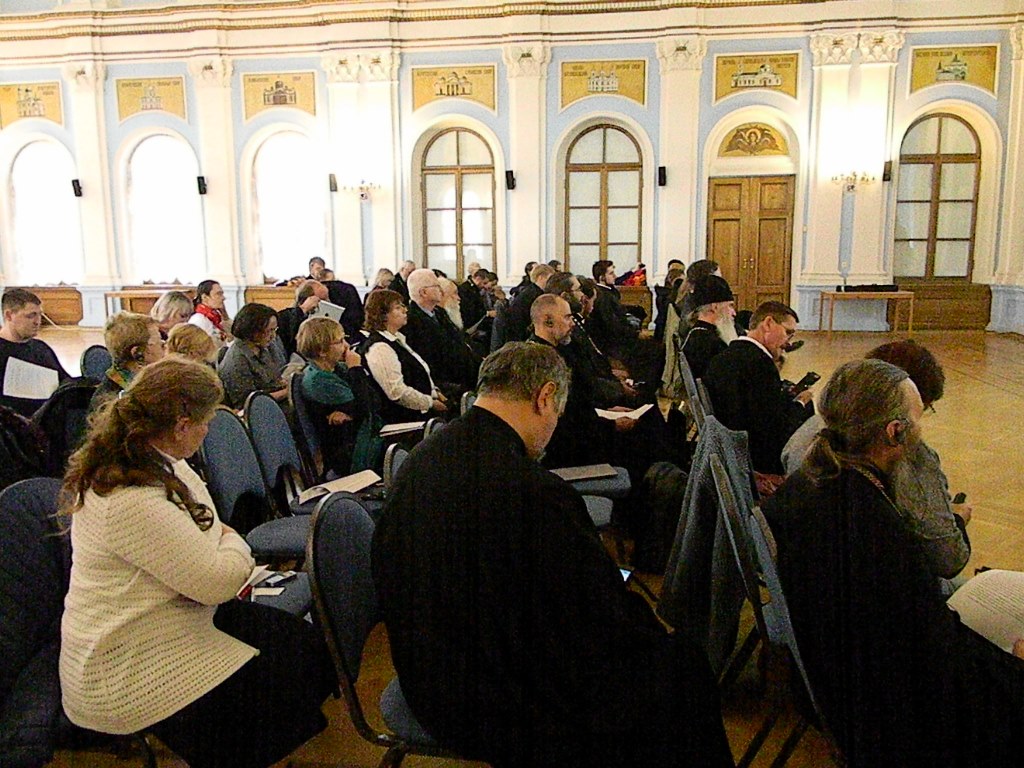
On October 1-2, 2018, an international conference was held at the St. Alexander Nevsky Monastery on ‘Theological Understanding of Dependency Problems: Orthodox and Catholic Perspective’. It was organized by the Moscow Patriarchate department for external church relations (DECR) and the Russian Orthodox Metropolis of St. Petersburg in cooperation with charitable foundations ‘Diakonia’ (St. Petersburg) and ‘Stariy Svet’ (Moscow) with the support of Kirche in Not. It was attended by 60 people – clergy, church social workers and experts from Russia, Poland, Romania, Germany and Belarus.
The conference was opened by the moderator of the meeting, Bishop Mefody of Kamenets and Alapaevsk, head of the coordinating center for opposing drug addiction of the Russian Orthodox Church department for church charity and social service.
Rev. Constantine Perederiy, rector of the Catholic seminary of Mary the Queen of the Apostles, greeted the gathering. He noted the positive aspect of cooperation between the Orthodox Church and the Catholic Church pointing out to the special importance given in this work to a prospect of developing a program for work with drug-dependent people for theological schools so that seminarians could be better equipped in their encounter with problems of dependence.
Peter Gumenyuk, head of the Kirche in Not/Russia, in his speech of greeting, pointed to the international nature of the conference and thanked Metropolitan Varsonofy of St. Petersburg and Ladoga on behalf of his foundation for the support he gave to the preparation and conduct of the forum.
Bishop Mefodiy, in his papers on ‘Dependence as a Passion’, called to address asceticism and patristic experience that speak of the eight basis passions, with the rest being a combination or derivatives from them. This is true for the sin of drug addiction. ‘There is always a parent passion, and this passion becomes an integral part of its progeny – drug addiction. Starting to struggle with drug addiction, an individual should look into what has generated his passion, and only in this case it is possible to prescribe the right course of spiritual healing’, he said.
Rev. Julian Negru, head of the anti-drug program of the Romanian Orthodox Church, in his paper on ‘The Parish as a Therapeutic Community’, presented various models of dependency treatment, in particular, a medical one, and pointed to its shortcomings. ‘In the moral model’ adopted by parishes, a drug addicts is not considered a victim as he is responsible to his own behaviour and actions. ‘Our goal is invariable – to reintegrate a person into the life of a parish’, Father Julian stressed.
Rev. Cyril Gorbunov, general vicar of the Catholic Archdiocese of the Mother of God in Moscow, presented a document of the Roman Catholic Church entitled ‘Church: Drugs and Drug Addiction’. According to the speaker, this document can be useful for Orthodox specialists as well. It states in particular that the Catholic Church is categorically against the liberalization of drugs and substitution therapy, against the division of drugs into light and heavy ones. Interesting are recommendations to pastors in their communication with drug-dependent people. ‘What is important is the ability to accept and to hear. It is often peculiar for drug-dependent people to have a high demand for spiritual life. Sometimes it is stronger than it is among most healthy people. A priest should meet this demand’, Father Cyril noted. The most important part of pastoral approach, he said, is ‘help in finding hope’.
Deacon Alexander Semenov read out a paper from Archpriest Sergiy Belkov, head of the anti-drug network of rehabilitation centers in the diocese of Vyborg, on ‘An Analysis of the Notion of Passion in Christian Anthropology and Addiction in Today’s Psychology’. According to the author of the paper, the notion of passion and addiction can be identified but the notion of passion is broader as it is linked with the notion of sin.
Dr. Sebastian Moldovan, professor of moral theology, social ethics and bio-ethics at the Liucian Blaga University of Sibiu, in his paper on ‘What Kind of Illness is the Vice of Dependence?’, posed the following questions: Dependence, is it a passion or an illness? Alcoholism, is it the same as hard drinking?... Traditional Christianity considers alcoholism a vicious behavior. However, in the 19th century, there emerged a different interpretation of this issue: alcoholism is an illness similar to diabetes II, obesity, Alzheimer’s decease, he noted.
Father Paul Chmur, director of the Franciscan San Damiano center for preventing dependencies (Poland), spoke about the rehabilitation of dependent people in a monastery in which the brethren live together with rehabilitants, pray with them in the same chapel, and people in the nearby villages give them support. Working in the center are specialist doctors from the National Health Foundation. ‘Each patient has his or her own therapist and individual therapy and each has to identify the source of his dependence; there are also prayer groups’, Father Pavel related.
Ms. Yelena Rydalevskaya, executive director of the Diakonia charity, presented a paper on ‘Dependence as Alienation’. ‘Drug addiction or alcoholism lead to the maximal disorder of all the mental powers of a person – intellectual, sensual and passional. We find the most precise definition of the state of those dependent on alcohol and drug in St. Paul: They are darkened in their understanding and separated from the life of God because of the ignorance that is in them due to the hardening of their hearts. Having lost all sensitivity, they have given themselves over to sensuality so as to indulge in every kind of impurity, and they are full of greed (Eph. 4:18-19). Strikingly, this description coincides to a great extent with the definition of six signs of addition described by Prof. V. D. Mendelevich in the 20th century: continued use despite harmful consequences, need to take a substance or to excite a certain activity (in case of gaming disorder), impairment of the ability to control one’s actions, abstinence syndrome, signs of tolerance, progressing disregard for alternative interests’. Having looked in detail into these signs, Ms Rydalevskaya concluded: ‘In a broad sense, the Church of Christ herself is primordially a beneficial therapeutic space for a person ill with dependence on the sin of humanity. Therefore, there is nothing new in our process of rehabilitation, except for specialization according to the most asocial dependences. But there is inevitably a new language of definitions and a detailed development of ascetic actions, that is, specific exercises in self-discipline, self-restriction and reflections aimed at inner transformation and change conformable to modern realities, which ultimately lead to full and profound understanding and change in one’s own distorted nature of a person who take these actions’.
Archpriest Maxim Pletnev, head of the coordinating center for opposing alcoholism and drug addiction of the St. Petersburg diocesan department for charity and social service and leader of the Orthodox charitable organization ‘Favor’, presented a paper on ‘A Theological View of Dependence on Psychoactive Substances. Speaking about the theological aspects of dependence, he underscored that a person who uses drugs ‘falls into a false dark spirituality’. Dependence on psychoactive substances is a false religiosity. ‘True happiness is a life with God, eternal blissfulness. Not living with God, not having a firm foundation in faith, a person, in his attempts to find happiness, actually finds surrogates of happiness, its substitutions. Instead of true blissfulness, which can be attained through work and God’s grace, a person received anti-blissfulness – a sinful pleasure’, he believes.
Evgeniy Protsenko read out a paper of Archimandrite Meletios (Webber), a cleric of the church of St. Nicholas of Myra in Cilicia on ‘Problems of Attitude to Alcohol and Alcoholics’. Unlike those who are ill with oncological diseases and who command sympathy and compassion, ‘an alcoholic dying from alcohol abuse does not command any sympathy. The feelings he can provoke among those around him are far from any compassion. It is rather disappointment, shame, offence… An important qualitative difference between cancer and alcoholism lies in people’s attitude to those who suffer from these diseases… Our attitude to anything is often based on prejudice… The most important thing in all this is the fact that this attitude constitutes a starting point in our spiritual journey – a journey in which the Lord wants to save us. The Church as the Body of Christ has not and cannot have a negative attitude to anything… If a person who is suffering from appendicitis comes to church, we will naturally send him to hospital that will give him an opportunity to receive physical treatment from other people outside the Church. In this case, the person will probably come back to church to receive ‘spiritual’ treatment that can be offered by the Church.
Psychologist Yevgeniy Protsenko, director of the Christian charitable foundation ‘Stary Svet’, presented his paper on ‘Various Influences Made on Modern and Archaic Ideas of Dependency and Co-dependencies by Theological Views on These Phenomena’. Speaking about modern studies, he pointed to the genetic nature of such disease as alcoholism. There are ethnoses (for instance, North American Indians) who develop problems with the first use of alcohol.
Hegumen Iona (Zaimovsky), director of the Orthodox rehabilitation center ‘Metanoia’, in his paper on ‘Theology and Dependence’, pointed to the importance of the holistic understanding of dependence and the relevance of the experience gained by the Catholic Church in the work with dependent people.
The paper of Archpriest George Aquaro, MDiv (Potlatch, Idaho, USA), on ‘Dependence as a Psychological and Sensual Disorder’ was read out by Rev. Julian Negru. The author of the paper addressed patristic texts including Loving-Kindness, and admonitions in the struggle with temptations. ‘Drug addicts often have a great experience of feeling fear, which makes them use drugs. This tendency to experience a strong anxiety, first physically and then emotionally and finally in action, is a key part of the experience of most drug addicts. It is only through the full commitment to God that a drug addict can begin understanding that his feeling of fear is distorted and begin finding strength to experience it without using drugs’.
Ms. Yekaterina Savina, director of the rehabilitation charitable foundation ‘Zebra & Cо’, spoke about peculiarities of the spiritual rehabilitation of drug-addicts and alcoholics. ‘Recovery is possible only with God and in God. A meeting with God – this is what can help a drug-addict and an alcoholic’, she said. As for coming in touch with a dark spirituality, according to her observation, ‘the work of devil is visible in a drug addict. It is not being possessed in the literal sense of the word, but it is the devil that a convalescent is opposing’, she underscored. The criteria of recovery are honesty and gratitude.
Ms. Larisa Shekhovtsova, PsyD. professor at the chair of church-practice disciplines of St. Petersburg Theological Academy, read a paper on ‘Psychological and Spiritual Symptoms of Dependency as a Passion’.
Archpriest Alexiy Agapov, leader of the Metanoia-2 rehabilitation program, in his paper on ‘Invalidity as a Hermeneutic Principle in Pastoral Work with Dependent and Co-dependent People’, shared his experience of psalmo-therapy – the use of the Psalter as an instrument capable of bringing out a response in the heart of a drug-addict.
In conclusion of the conference, Bishop Mefody again called upon the participants to search for answers in the works of holy fathers and to continue the dialogue on the theological understanding of problems of dependence at future forums.
DECR Communication Service